How to Balance Studies, Work, and Personal Life as a Student
The modern student is no longer just a learner. You are likely an employee, a family member, a friend, and a caretaker of your own mental health. Juggling a part-time job (or full-time gig), a demanding course load, and a desire for a social life often feels like a circus act where the rings are on fire.
According to a 2023 survey by the National Education Association, nearly 80% of undergraduate students work while enrolled. The result? Chronic stress, burnout, and a nagging feeling that you are failing at all three fronts simultaneously.
But balance is not a myth. It is a system. Here is the complete guide to surviving—and thriving—as a student with a full plate.
The Mindset Shift (Before You Look at a Calendar)
Before you buy a fancy planner, you need to rewrite the rules of engagement.
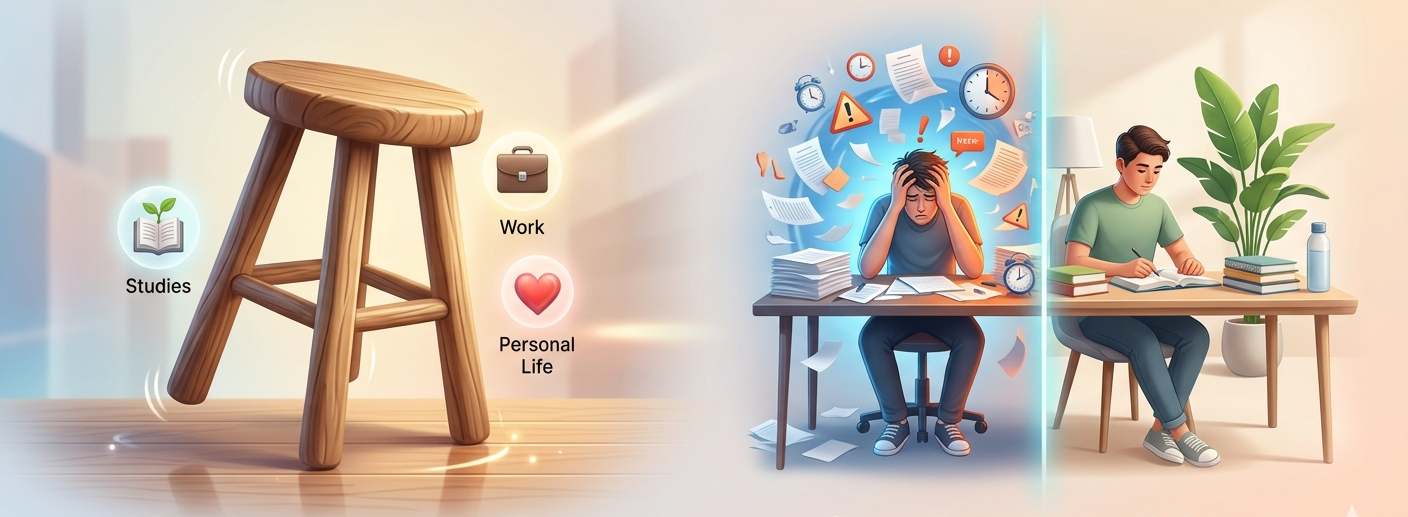
1. Accept the “Three-Legged Stool” Principle
You cannot give 100% to studies, work, and life every single day. Some days, work will get 80% of your energy. Other days, a personal crisis will take the lead. Balance isn’t equal distribution; it’s prioritized rotation. If you accept that one leg of the stool will wobble occasionally, you won’t panic when it does.
2. Kill the “Perfect Student” Myth
You will not get an A+ on every assignment. You will not be the employee of the month. You will miss a friend’s birthday dinner. That is not failure; that is reality. Aim for “B+ work” in non-essential tasks and reserve your A-game for the priorities that truly move the needle.
The Academic Strategy (Working Smarter, Not Harder)
Before you buy a fancy planner, you need to rewrite the rules of engagement

The “Power Hour” Method
Do not study for four scattered hours. Study for one hyper-focused hour. Turn off your phone, use a Pomodoro timer (25 mins work, 5 mins break), and force deep work. One productive hour is worth three distracted hours.
Leverage “Dead Time”
You have pockets of lost time daily: commuting to work, waiting for a shift to start, standing in the lunch line. Use these for low-stakes studying—flashcard apps (Anki/Quizlet), listening to a recorded lecture, or outlining a paper. This protects your evenings for personal life.
Communicate with Professors Early
Most professors are human. If you have a massive work deadline that coincides with a final paper, tell them two weeks in advance. Do not wait until the night before. Proactive honesty (“I work Tuesdays and Thursdays; can I take the quiz on Monday?”) is almost always rewarded.
The Work Strategy (Setting Boundaries)
Your job pays the bills, but it should not ruin your degree.
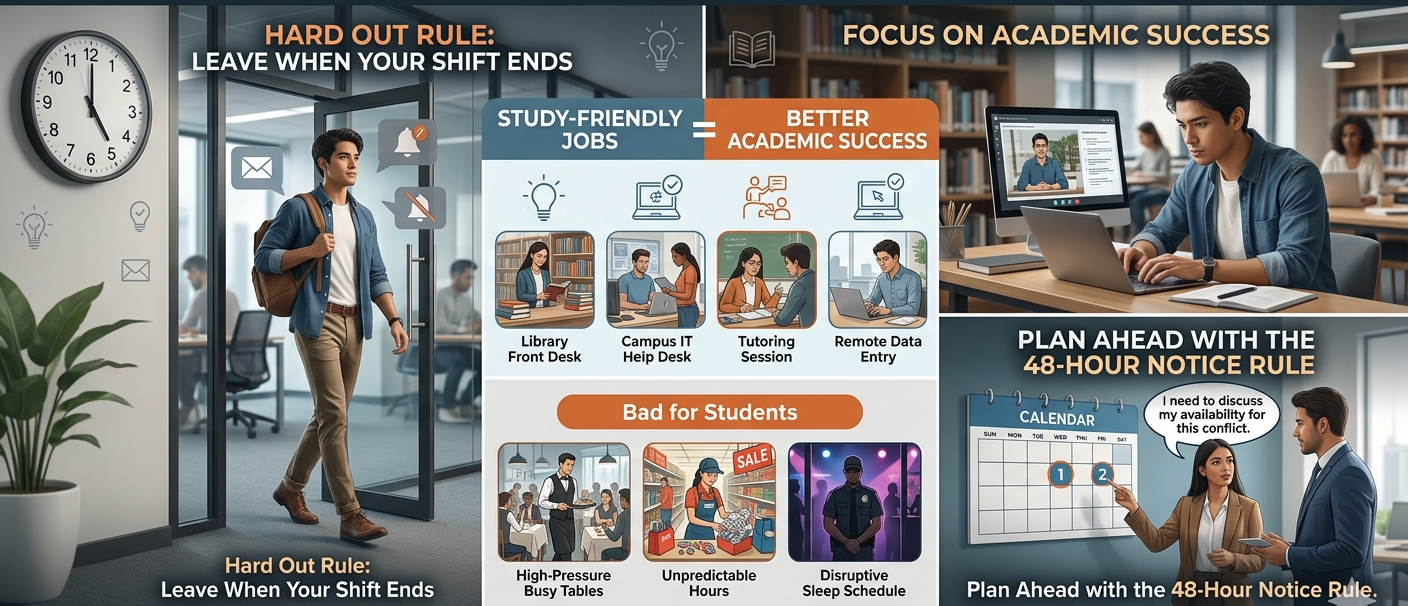
The “Hard Out” Rule
When your shift ends, leave. Do not stay late “just this once” unless it is a literal emergency. Do not answer work emails during class. By establishing a hard out, you train your boss and your brain that work time is distinct from study time.
Find “Study-Friendly” Employment
Not all jobs are created equal.
Bad for students: Waiter (random hours), retail (holiday crunch), nightclub security (ruins sleep).
Good for students: Library front desk (you can read), campus IT help desk (downtime to study), tutoring (reinforces your own knowledge), or remote data entry.
If you can, trade higher pay for lower cognitive load. A boring job where you can review notes is better than an exciting job that drains your will to live.
Use the “Two-Day Notice” Rule for Work
When a work shift and a study deadline clash, give your manager at least 48 hours’ notice to swap or drop a shift. Last-minute requests annoy them; advance planning makes you a responsible employee.
The Personal Life Strategy (Guilt-Free Rest)
This is the area students sacrifice first, which leads to burnout. You cannot pour from an empty cup.
The “Non-Negotiable” Hour
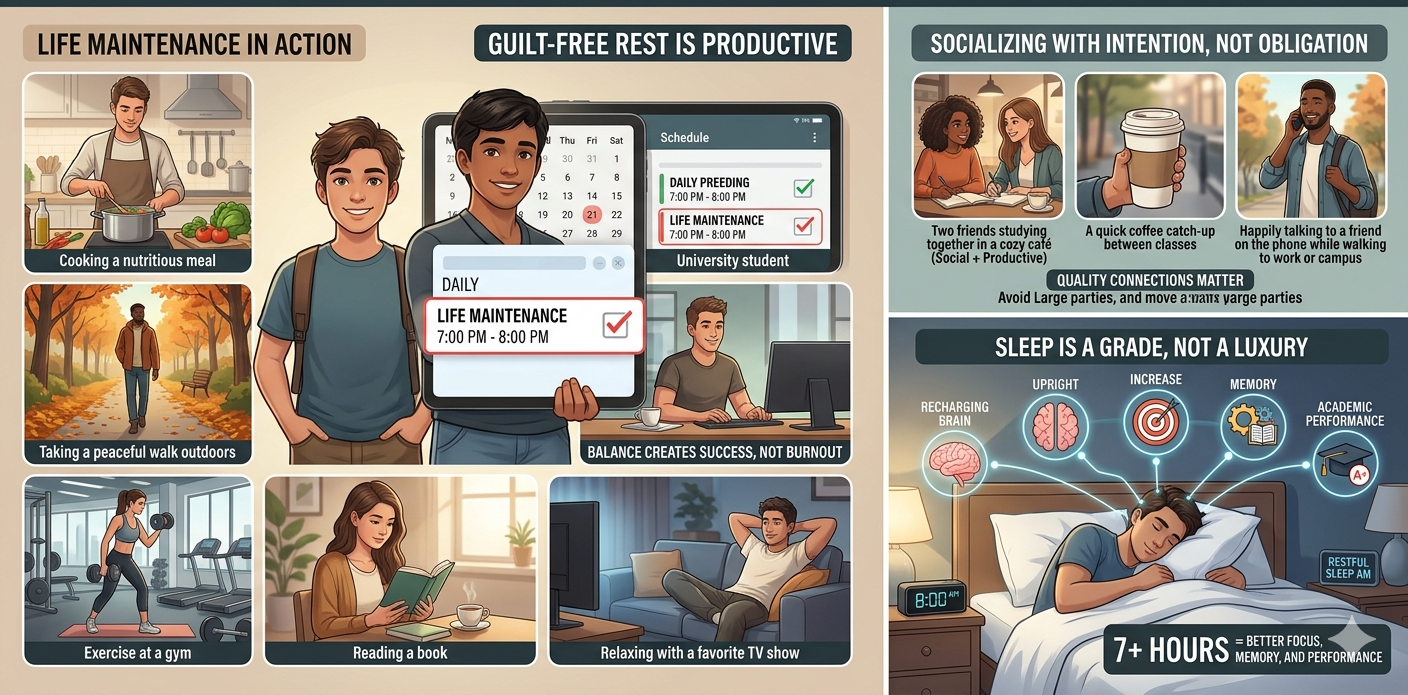
Block out one hour every single day that is reserved for you. No work. No school. This hour is for: cooking a real meal, calling a parent, walking outside, lifting weights, or watching a mindless TV show. Put it in your calendar as “Life Maintenance.” If you miss it three days in a row, you are backsliding into burnout.
Socializing with Intention
You don’t need to go to every party. You need quality connection.
The “Combo” move: Study with a friend at a café (social + productive).
The “Lunch date” rule: Schedule a 30-minute coffee catch-up between classes instead of a 4-hour dinner party.
The “Phone call while commuting” : Call your best friend during your walk to work.
Sleep is a Grade, Not a Luxury
Sleep deprivation reduces cognitive function to the level of being legally drunk. If you are skipping sleep to study, you are learning less and remembering nothing. 7 hours minimum. Treat it like a required course.
The Weekly System (Putting It All Together)
Vague intentions fail. Systems succeed. Here is a simple weekly workflow.
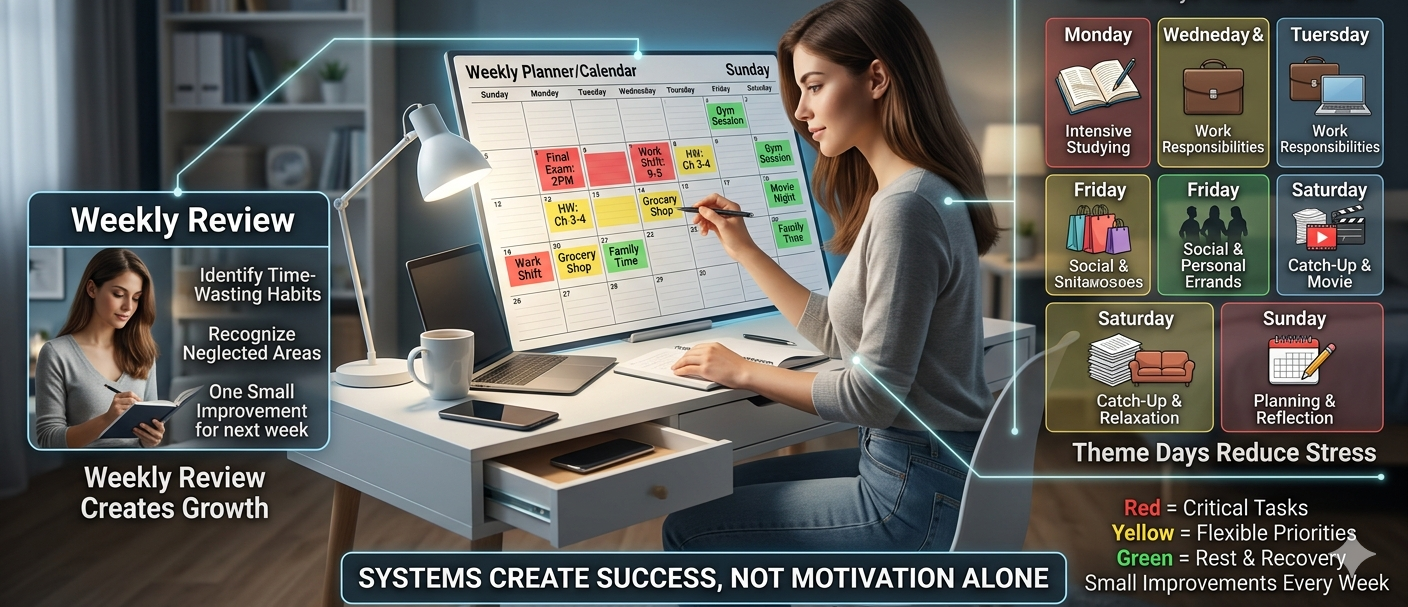
Sunday Night: The “Traffic Light” Planning Session
Take 15 minutes to review the upcoming week.
Red tasks (Critical): Exams, work shifts, doctor’s appointments. Block these first.
Yellow tasks (Important but movable): Homework, laundry, grocery shopping. Schedule these around the reds.
Green tasks (Restorative): Gym, movie night, calling a friend. Schedule these before you fill the gaps. Treat green tasks as mandatory.
The “Theme Day” Strategy
Instead of switching modes ten times a day, batch your focus.
Monday/Wednesday: Heavy study days.
Tuesday/Thursday: Heavy work days.
Friday: Social & chores.
Saturday: Catch-up and rest.
Sunday: Planning.
When you know “Tuesday is for work,” you stop feeling guilty about not studying on Tuesday night.
The Weekly Review (30 minutes)
Every Friday, ask yourself three questions:
Where did I waste the most time? (e.g., 2 hours on TikTok)
Which area did I neglect? (Work, study, or self?)
What is one small fix for next week? (e.g., “I will put my phone in another room while studying.”)
When It Breaks (Emergency Protocols)
Even the best systems fail. Here is the triage guide.

| If you feel… | The problem is… | The fix is… |
|---|---|---|
| Drowning in assignments | Poor estimation of workload | Drop one course or ask for an extension. Your GPA can take a B; your health cannot take a breakdown. |
| Hating your job | The job is toxic | Quit. Find a campus job or gig work (Uber, tutoring). No job is worth your degree. |
| Lonely & isolated | You cut out “green” tasks | Force a low-stakes social event. Go to a study group or a club meeting for 45 minutes. |
| Exhausted but can’t sleep | High cortisol (stress hormone) | Do a 10-minute “brain dump”: write down every worry on paper. Then do 4-7-8 breathing (inhale 4 sec, hold 7, exhale 8). |
The Final Truth: You Cannot "Have It All" Every Week
Even the best systems fail. Here is the triage guide.
The student who works 30 hours, takes 18 credits, and goes to parties every night is lying to you (or failing a class). Real balance requires saying “no” a lot.
No to the extra shift when you have an exam.
No to the Netflix binge when you need sleep.
No to the friend who guilt-trips you for being busy.
But here is the good news: This season of life is temporary. You are building the discipline that will make you a killer employee and a grounded adult later. Every time you choose the boring study session over the party, or the early bedtime over the video game, you are investing in a future where balance comes easier.
You can do this. Not by being a superhero, but by being a smart manager of your own energy.
Start today. Open your calendar. Find one hour this week that you will claim just for you. The rest will follow.

Continue Your Learning Journey
Interested in learning more about cybersecurity, data protection, online privacy, and digital safety?
Explore our Insights Hub for expert articles, practical guides, industry trends, and actionable tips designed to help students, professionals, and organizations stay secure in an increasingly digital world.
Article by: Kalana Chethiya
MSc (Reading) in Science for IT & Strategic Innovation – Kingston University
BEng (Hons) Software Engineering (Top-Up)
Published by: Sipway Campus